What is Psilohuasca? A Guide to the Blend.
Begin Your JourneyWhat is Psilohuasca? Guide to the Ayahuasca & Psilocybin Blend (Benefits, Risks & Retreats)
Discover how this potent combination of magic mushrooms and MAO inhibitors is leading the charge in psychedelic therapy.
In a world where trauma is pervasive and stresses mount amidst increasing instability, imagine going to a place where all this drops away and you’re bathed in healing, magical energy.
That’s what’s possible with psilohausca.
What is psilohuasca? It’s a fair enough question to ask, as this medicine is at the leading edge of psychedelic healing.
Psilohuasca is the result of combining the psilocybin from magic mushrooms with some of the plants used in ayahuasca like Banisteriopsis caapi or Syrian Rue, which contain MAO inhibitors. Adding the MAO inhibitors to the psilocybin makes the experience longer and deeper. It also blends the insights offered by the mushrooms with the earthy, introspective experience of ayahuasca.
In this article, we’ll look at what psilohuasca is, how it’s different from a mushroom trip and why people on the growth and healing paths are so excited about it.
The Science of Psilohuasca: How MAO Inhibitors Enhance the Psilocybin Experience
The merging of magic mushrooms with MAO-inhibiting plants results in a brew that holds the best of a psilocybin and ayahuasca journeys.
MAO inhibitors (MAOIs) slow down how the body breaks down psilocybin. This takes an experience that normally lasts four to six hours and turns it into a trip that can go on for eight hours or more. The journey also gets more intense, including deeper emotional release, trippier visuals and deeper feelings of connection and insight.
The MAOIs in ayahuasca brews, a plant like Psychotria viridis that has DMT in it gets mixed in with Banisteriopsis caapi, a vine rich in MAOIs. MAO (monoamine oxidase) is an enzyme in the body that keep DMT inactive when it’s taken orally. MAOIs allow the DMT to activate when consumed in a brew and make the magic of an ayahuasca journey possible.
So you could think of psilohuasca as a mushroom “counterpart” to ayahuasca. Psilocybin replaces the Psychotria viridis as the source of DMT and the MAOI increases the mushrooms’ effects.
Psilocybin acts mostly on the serotonin 5-HT2A receptors to give us altered visual, mental and emotional experiences. MAOIs make the experience last longer and go deeper, so there’s more potential for neuroplasticity. That means more possibility for emotional breakthroughs, lasting shifts and deep change. Like most psychedelics, psilohuasca has huge capacity to support trauma recovery, heal depression and reduce anxiety.
The Psilohuasca Experience
Like its ayahuasca counterpart, psilohuasca can be a deeply spiritual experience. You can expect unity with nature, deep compassion, ego quieting and feeling part of something bigger than this limited self.
When I took a hero dose of psilohuasca (with a sitter, of course), I left my body and became independent molecules existing on a plane in space time. I just laid on the floor listening to binaural beats and it was like going under anesthesia, except I was fully aware of my presence in the universe.
When I came out of the peak, I couldn’t stop laughing, putting strange and hilarious words together. It wasn’t incoherent though. It was actually hyper-coherent.
When you take a high dose like this, you have no concept of reality existing, so there’s no freak out. Freakouts usually only happen when you have one foot in reality, like when you take less than three grams and you’re fighting it.
But when you totally let go, that’s when the magic happens.
Warning though, don’t do this on your first experience with mushrooms. Start with a few 1 to 3 gram rides and get used to the effects. Then you can take a heroic dose and experience full release into a realm where you no longer fear death and worries just fade away.
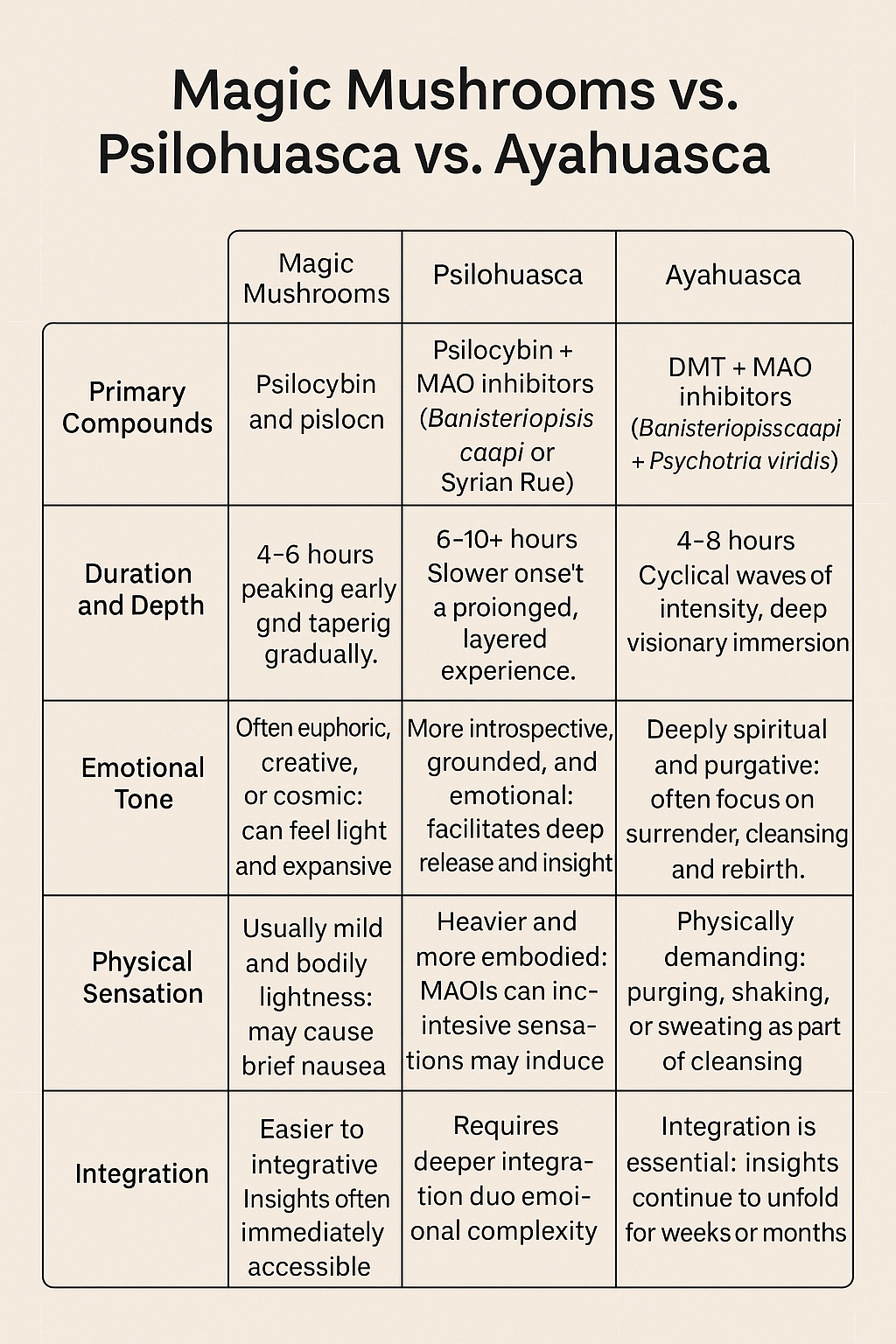
Magic Mushrooms vs. Psilohuasca vs. Ayahuasca Comparison
While magic mushrooms, psilohuasca, and ayahuasca all invite profound shifts in perception and consciousness, they differ significantly in chemistry, duration, and overall tone. Psilohuasca sits between the other two — blending the clarity of psilocybin with the depth and ceremonial grounding of ayahuasca. Understanding these distinctions helps seekers choose the medicine and setting most aligned with their intentions.
Key Takeaways
- Magic mushrooms tend to give shorter experiences, include more creativity and are less intense. This makes them approachable for beginners.
- Psilohuasca makes the mushroom journey longer and deeper. It’s a bit like a bridge between mushroom exploration and traditional plant medicine.
- Ayahuasca is kind of like the mother of psychedelics. It’s often the most spiritually and physically intense due to its connection to a strong lineage of shamanic ritual and purification.
So, psilohuasca brings together the psychedelic clarity of mushrooms with the spiritual significance of ayahuasca. It’s a middle path for folks who want to do deep inner work inside a grounded, introspective space.
Why Choose a Psilohuasca Retreat? Deep Healing & Emotional Breakthroughs
If you’re made it this far, chances are, you’re interested in a psilohuasca journey.
The healing power of psilohuasca is most potent in the safe, supportive container of a professionally guided retreat.
Because psilohuasca makes the psilocybin experience longer and more intense, it lets you go further into the subconscious. The longer time frame and deeper dive opens space for major emotional release, trauma unwinding and rooting out deeply held patterns. You could think of it as a full internal psychological and spiritual reset.
For that, you definitely want a well-facilitated psilohuasca retreat. These usually include shamanic or ceremonial aspects like intention setting, breathwork, music and post-journey sharing circles.
These practices help you stay grounded during what can be a challenging experience and integrate what you learn post-journey. That integration is the most important part of a healing journey because it lets you explore how you can take the experience and put it to work in your life. It makes the difference between a meaningful retreat and an isolated psychedelic trip.
People who’ve attended psilohuasca retreats often say they’re made breakthroughs with: trauma and emotional blocks, depression, anxiety and addiction, and struggles with purpose or spiritual disconnection.
Unlike your standard psilocybin retreats, which tend to follow a more psychological or clinical model, psilohuasca retreats usually have more of a spiritual and holistic flavor. Adding in the MAOIs give the experience a slower rhythm and deeper emotional tone. The ceremonial component pays homage to the traditional Amazonian origin of the mushroom medicine.
Because of the MAOI component, safety and preparation are must-haves. Reputable retreat centers include medical screenings, provide dietary guidance to avoid MAOI interactions and make sure you’re held by experienced facilitators.
Unlike a solo trip that can feel more like an experiment, qualified guidance can give you a therapeutic experience by creating an environment where the healing can happen safely and naturally.
Potential Risks and Cautions
Because the psilohuasca experience involves MAOIs, it’s important to understand the potential risks and precautions of ingesting these substances before heading off to a retreat.
MAOIs temporarily block the monoamine oxidase enzyme, which helps break down some chemicals in food and medication. With this enzyme out of the picture, dangerous interactions are possible.
So, you’ll need to stay away from foods that have a lot of tyramine, like aged cheeses, cured meats, soy products and fermented foods prior to the journey. Too much tyramine can raise your blood pressure when combined with MAOIs.
Some medications also don’t mix well with this brew. Some of the main ones are:
- SSRI and SSRI antidepressants
- Prescriptions MAOIs for depression (these increase the MAO inhibition, which can be dangerous)
- Blood pressure medications
- Stimulants or amphetamines
Taking these together with psilohuasca can cause bad side effects like extreme hypertension or serotonin syndrome. So medical screening and full disclosure about medication use are must-haves before any retreat.
Along with physical risks, the potential for psychological damage is real. Psilohuasca can take you deep. So if you have a personal or family history of psychosis, bipolar disorder or severe anxiety, you should proceed with caution or maybe just take a pass on psilohuasca for now.
This kind of journey can unearth strong feelings and buried memories, which can be overwhelming without proper support.
Because of these risks, psilohusaca safety leans strongly on a safe environment and competent facilitation. The best retreat centers do detailed intake assessments, offer pre-ceremony dietary guidance and have trained facilitators and medical staff on site.
So, like any plant medicine or psychedelic, psilohuasca isn’t generally unsafe. But you have to meet it with respect, education and professional support.
Integration and Post-Journey Care
Speaking of professional support, having someone to help with integration after the journey is a must. That’s when the real work starts.
The hours and days after the ceremony are a time for integration—when insights, feelings and epiphanies get brought into everyday life. It’s so important that it’s sometimes called the “second ceremony.”
After a psilohuasca journey, it’s normal to feel very emotionally open and highly attuned to your environment. This is prime time for practices that help you organize and anchor your takeaways from the retreat.
There are many ways to integrate, from walking in nature to more deliberate practices like:
- Journaling to record details, emotions and insights as they arise and before they fade. This can help turn abstract experiences into solidified understanding.
- Therapy or coaching with someone experienced in plant medicines or psychedelics can help you make sense of your experiences and navigate any difficult thoughts or feelings that might show up.
- Meditation and breathwork are excellent tools for helping you stay grounded amidst new experiences that come up, and also for continuing to build on the new neural pathways opened up through your journey.
- Community and sharing circles allow you to connect with other people who have had similar experiences. This helps reduce any feelings of isolation that might come up as you confront new perspectives and ways of seeing the world.
These integration practices can turn your insights from ceremony into real change. It’s not just something you have to do because someone said it’s a good idea. It’s a critical part of a psilohuasca journey.
A Dance of Two Medicines
While psilohuasca is at the forefront of psychedelic exploration, it’s also a bridge between two ancient plant teachers. Together, the visionary nature of mushrooms and the introspection of the vine represent a dance between two deeply rooted healing traditions.
Psilohuasca can be a tool for emotional release and renewal. It’s can also offer a deeply spiritual experience that reconnects you to nature, purpose and previously unknown aspects of life.
No matter your intention, psilohuasca demands the same qualities that plant medicine ceremonies have required for millenia: respect, preparation and humility.
If you approach psilohuasca with the right mindset, in the proper setting and with experienced guidance, it can teach you what you need to know in a safe and meaningful way. When held with reverence, this combo of medicines becomes a vehicle for returning—to balance, wholeness, awareness and connection.
The Behold Retreats Psilohuasca experience
If you’re feeling called to explore psilohuasca in a safe, professionally guided environment, Behold Retreats offers a world-class experience designed for deep transformation.
Our retreats blend scientific integrity with compassionate facilitation and holistic preparation and integration to ensure every journey is both meaningful and safe.
Psilohuasca retreats with Behold are a blend of intentional ceremony and nature-based exploration that help participants reconnect with themselves and their world.
The journey usually starts with a gentle low-does “planting seeds” experience in nature that awakens childlike curiosity and sensitivity to the textures, colors and rhythms of the environment. This opening is supported by practices like a Hapé ceremony and a Temazcal or traditional sweat lodge. Each of these adds a unique emotional and energetic tone to prepare mind, body, and spirit for deeper work.
The retreat’s centerpiece is the nighttime macro-dose ceremony. This is a guided inner voyage supported by our experienced facilitators and talented musicians. In this extended session, you find space to open to surrender, healing and profound self-discovery. The following day is all about integration, rest, nourishment, community connection and grounding. These practices help participants make sense of what they experienced and settle into a calmer, more regulated state.
A daytime ceremony with a medium dose later in the week gives a chance for participants to explore their senses and intuition through painting, writing, singing and movement.
Human connection is emphasized throughout the retreat as much as the medicine itself. This helps inspire a sense of community, clarity and purpose. By the end, guests often leave with new insights, a clearer path forward and a greater sense of joy, presence and possibility.
Join Our Psilohuasca Retreat Waitlist
We know that approaching this work takes trust and preparation. That’s why we offer a Psilocybin Waitlist so you can learn more, ask questions and prepare for a transformative retreat when the time is right.
Are you ready to take a first step before your big leap?
Join our waitlist today to get early access to upcoming retreats, preparation resources and personalized guidance from our professional team. Drop your info, and let's connect.
Frequently Asked Questions About Psilohuasca
What is psilohuasca?
Psilohuasca involves combining psilocybin mushrooms with MAO-inhibiting plants like Banisteriopsis caapi or Syrian Rue. MAOIs make psilocybin’s effects deeper and longer for a more inward-oriented experience often compared to a mushroom-based version of ayahuasca.
How is psilohuasca different from ayahuasca?
Both of them involve using MAOI plants, but ayahuasca used DMT as the main hallucinogenic component and psilohuasca used psilocybin. Ayahuasca journeys usually involve fast, visionary images and physical purging, but psilohuasca is gentler, slower and more emotionally grounded. It’s usually seen as more introspective than visual.
How long does a psilohuasca experience last?
A psilohuasca journey lasts about six to ten hours, or maybe longer. The MAOIs slow the breakdown of psilocybin in the body, which brings about a prolonged, layered experience compared to the average mushroom trips, which usually last four to six hours.
What are the effects of psilohuasca?
Psilohuasca usually brings up vivid images, emotional catharsis, greater empathy and a deep sense of interconnection with all things. People often say they work with deeper psychological material than a regular mushroom experience, along with insights that feel spiritual or transformative.
Is psilohuasca safe?
Yes, it can be safe when it’s consumed under professional supervision with the right screening and support. But there are risks because of the MAOIs in it, which can interact with certain foods and medications. Also, taking psilohuasca when on SSRI or SNRI antidepressants, stimulants or blood pressure medications can be dangerous. So, medical clearance before a ceremony is critical.
What should I avoid before a psilohuasca ceremony?
You should stay away from:
- Foods high in tyramine (aged cheese, cured meats, fermented foods)
- Alcohol and caffeine
- Prescription medications that affect serotonin or blood pressure
Dietary and medical guidelines should always come from the retreat’s facilitators, who tailor advice to each participant’s needs.
What are the benefits of a psilohuasca retreat?
Psilohuasca retreat benefits include accessing deeper feelings, releasing trauma, connecting with spirit, and getting mentally clear. Many retreats include therapy, meditation, and group sharing, along with ceremonies to create a holistic healing environment that goes beyond the journey itself.
How does a psilohuasca retreat differ from a psilocybin retreat?
Traditional psilocybin retreats are usually structured around therapeutic use of mushrooms inside a psychological container. Psilohuasca, on the other hand, often includes shamanic or ceremonial elements, guided rituals and a slower, more introspective journey because of the MAOIS. So it’s a bit of a blend of science and spirituality.
e of MAOIs. It tends to blend science and spirituality more seamlessly.
Who should not take psilohuasca?
Don’t take psilohuasca if you are:
- Taking antidepressants or blood pressure medication
- Living with cardiovascular conditions
- Diagnosed with bipolar disorder, psychosis, or schizophrenia
- Pregnant or breastfeeding
Consult with a doctor and disclose any medical conditions and medications before getting to the psilohuasca ride.
What happens after a psilohuasca retreat?
After a ceremony, integration starts. Often called the “second ceremony,” integration includes reflection time, journaling, therapy and lifestyle changes to help integrate learnings from the journey into everyday life. Most people say this is where the real change happens.

The content provided is for educational and informational purposes only and should not be a substitute for medical or other professional advice. Articles are based on personal opinions, research, and experiences of the author(s) and do not necessarily reflect the official policy or position of Behold Retreats.
Let's Evolve Together.
Learn more about consciousness, plant medicine, and spiritual transformation